
Street light poles: tapered and stepped shafts, 3–14 m.
The shaft that carries almost every road and solar luminaire. Q235 / Q345 steel, wall 2.0–4.0 mm, base plate and anchor cage sized to the height, hot-dip galvanised 80–100 μm. Made to your drawing, 15–20 days.
Before the drawings.
Send it with the enquiry — road section or installation drawing, required outreach, luminaire datasheet, and the design wind speed for the site. That is enough to size the wall and the base against your own criteria rather than ours.
The standard road pole, by height.
One row per height. Top and bottom outside diameter, wall, base plate and anchor cage — the four numbers a structural check needs. Every row is what we build to when no drawing is supplied.
| Height | Top Ø | Bottom Ø | Wall | Base plate | Anchor cage | Typical lamp |
|---|---|---|---|---|---|---|
| 3–7 m | 60 mm | 130 mm | 2.0–3.0 mm | 250×250×T10 | 180×180×H500 · M16 | 50 / 60 W |
| 8 m | 60 mm | 150 mm | 2.5–3.0 mm | 280×280×T12 | 200×200×H700 · M18 | 80 / 100 W |
| 9 m | 60 mm | 160 mm | 2.75–3.0 mm | 300×300×T14 | 220×220×H900 · M18 | 80 / 100 W |
| 10 m | 70 mm | 170 mm | 3.0 mm | 320×320×T14 | 220×220×H1000 · M20 | 100 / 120 / 150 W |
| 12 m | 70 mm | 190 mm | 3.5 mm | 350×350×T16 | 250×250×H1200 · M24 | 150 / 200 W |
| 14 m | 90 mm | 230 mm | 4.0 mm | 450×450×T20 | 350×350×H1500 · M26 | 150 / 200 W |
How to read it — bottom diameter is the outside diameter at the base plate, top diameter is at the spigot. Typical lamp is the luminaire wattage usually paired with that height in open terrain, not a limit.
Two diameters, one straight line.
| Height | Top Ø | Bottom Ø | Wall, base plate, cage | Typical lamp |
|---|---|---|---|---|
| 8–12 m | 76 mm | 114 mm | As the tapered pole of the same height | 60 / 100 W |
| 10–14 m | 89 mm | 140 mm | As the tapered pole of the same height | 100 / 150 W |
Material and performance.
Material & structure
Finish & performance
Four places where a cheap pole fails.
Not the steel — the joints and the coatings. These four decide whether the pole is still straight and dry at the end of its service life.

Submerged-arc seam weld
The longitudinal seam is submerged-arc welded along its full length, then ground twice — coarse, then fine. The two passes take off spatter and slag and open up the seam, so any point where the weld did not fuse is found and re-welded before the shaft goes on. The surface stays clean: no thick bead left to coat over.

Base plate and gussets
Four gussets welded outside the plate, both sides of the weld. They take the overturning moment out of the shaft and spread it into the foundation instead of loading one weld line.
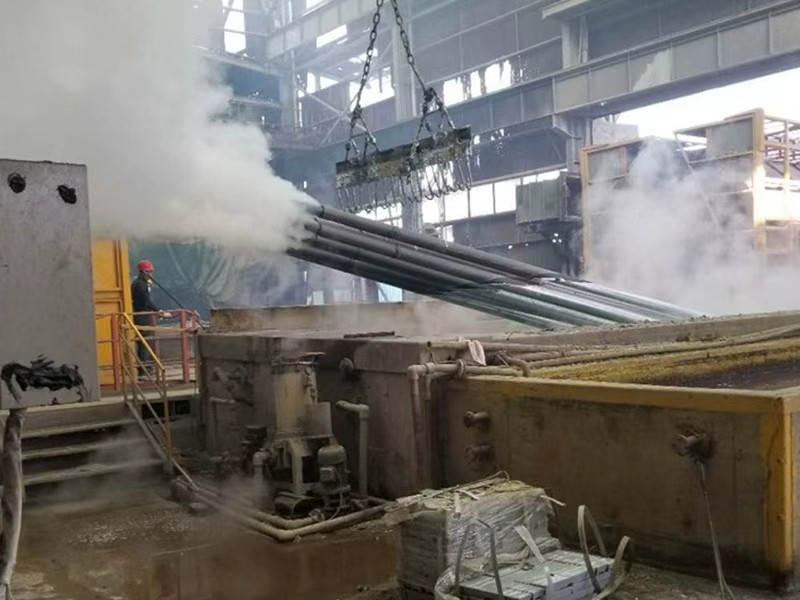
Hot-dip galvanising
The whole shaft goes into the zinc bath, so the inside is coated as well as the outside — and the inside is where condensation sits. 80–100 μm, in accordance with GB/T 13912 and ASTM A123.
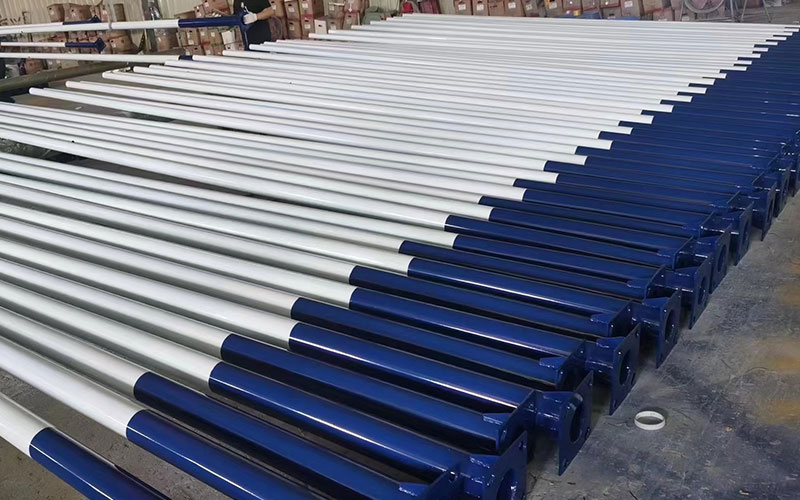
Powder coating, over the zinc
Phosphated first, then sprayed and cured at 200 °C, in any RAL. The zinc underneath is the corrosion protection — the paint is not. That is why we never powder coat bare steel.
Wiring, and how the arm arrives.
Neither of these affects how long the pole lasts. Both affect how it goes in on site, and how it fits in a container.

Handhole and cable route
500 mm door, 80×250 mm up to 8 m and 100×300 mm from 8 m. Reinforced frame, deburred edge, radiused entry so the cable sheath is not cut when it is pulled.

Arm connection
Two ways, and they are not interchangeable once the order is placed. Spigot fit: the arm slides over a Ø60 mm spigot and is fixed with two set screws, so arm and shaft ship as separate pieces — that is what saves container volume on a long arm. Welded: the arm is welded to the shaft in the factory and ships as one piece, which is more rigid but takes more space in the container.
Four numbers that hold up on site.
Five lines is enough for a firm price.
A drawing replaces all five. Without one, this is what we need to quote without guessing.
Garden and courtyard work — parks, villas and residential schemes use our courtyard and garden poles — steel or aluminium, 3 / 3.5 / 4 m, drawn to a photo or to a drawing.
The full pole range, all sections and process →Straight answers.
Tapered or stepped — which one do I need?
Tapered for anything up to 14 m, which is most road and solar poles. Stepped when the pole has to stay slim at the top over a long span, or when the drawing calls for two different diameters.
What wall thickness should I specify?
The table gives the range we build to at each height. Below 8 m, 2.0–3.0 mm is normal. At 12–14 m, 3.5–4.0 mm carries the overturning moment of a 200 W luminaire in open ground. If you give us the wind load and the luminaire weight, we size it for you.
Can you match an existing pole on site?
Yes. Send the top and bottom outside diameter, the height and one photo of the base. We come back with a drawing that matches what is already standing.
Do anchor bolts come with the pole?
Yes. The cage in the table is the bolt circle and the bolt size, supplied with the pole. Template plate and nuts are included.
Flange or direct burial?
Flange mounted is standard and the tables above are built around it. Direct burial is available — the shaft is extended below ground line and we add the corrosion allowance, so tell us the burial depth.
What is the lead time for 100 poles?
15 to 20 days from PO to finished goods, galvanising included. A mixed lot with several heights takes the longer end. We confirm the date before you order, not after.
Can the pole carry a solar panel and battery?
Yes. The shaft is the same; the top gets a panel bracket and the battery goes in the handhole or a separate box. Send the panel size and we adjust the wall thickness.
Do you supply the luminaire too?
We can, but this page is pole only. If you want pole plus luminaire aimed to a layout, the stadium and high mast pages cover the packaged version.
Send the drawing, get a price in 24 hours.
Height, shaft section and quantity are enough to start. We come back with a firm price, freight separate, and a shop drawing for approval before any steel is cut.
· Guangdong Lifan Lighting Co., Ltd